A family pays tens of thousands of dollars a year and the engagement runs three to four years. The parent signs on trust. Then, for most of those years, they see very little.
Strategic foundation
Aligning Architecture with the Economics of Retention
That gap is where the money leaks. Families rarely leave because the work was bad. They leave because twelve months went by, nothing was visible, and they drew their own conclusion.
So we didn't start with screens. We started by asking where the revenue comes from and why clients walk. Everything below came out of those two answers.
Stakeholder alignment
Re-architecting Interaction Focus: From Student Operation to Parent Verification
The brief called for a portal where students log in and follow their own progress.
Research said otherwise. The people who log in week after week, and who use what they see to judge whether the money was well spent, are the parents. The student is who the service is for. The parent is who uses the software.
So the design assumption changed. We rebuilt the interface around how a parent reads rather than how a student operates, and we cut the student's ability to edit records. One accidental change and the report a parent receives is wrong, and that lands on the institution.
We didn't only take things away. Students got somewhere to upload their own materials and access to a shared resource library. Each role ended up able to do the things that role actually does.
Early structural sketch: mapping student operational scope vs. parent reading viewport.
Client experience architecture
White-Glove Onboarding: Eliminating Friction for High-Value Families
Standard practice would be to email the family a registration link once they sign.
We argued against it. A parent who has just committed to years of fees at this level, and is then asked to create an account, verify an email and pick a password, has been handed a chore at the exact moment they are most sensitive to how they're being treated.
Accounts are created by the institution instead. The family gets a welcome pack and one link, and lands in a workspace that already has their student in it.
It costs an admin about a minute per account.
Institutional knowledge protection
Institutional Asset Protection: Centralizing Client History and Enforcing Granular Permissions
In this industry the most common way to lose a family is not poor results. It's a consultant walking out the door.
Trust attaches to a person. When that person resigns the family often follows, and the institution is left holding an empty file. It usually can't even prove what happened.
A back-office system that ignores this is helping the consultant build his own client list.
We restricted export and cross-student access at the consultant level and consolidated the complete view and full history under the admin account. Consultants get everything they need to do the work. They can't walk out with the institution's assets.
Marketing site interface: anchoring authority on institutional leadership and proven outcomes.
Strategic advisory
Refining Roster Presentation: Anchoring Authority on Institutional Leadership
The client wanted a page in the brochure listing every mentor on the roster. His reasoning was sound. The first thing a parent wants to know is the strength of the teaching team.
So we built it. Then we sent both versions over with three concerns attached:
- 1. The pricing would be misread. This brochure exists to support three and four year contracts at premium rates. A full page of junior mentors reads like an hourly tutoring service rather than a managed program, and the basis for the pricing quietly goes with it.
- 2. Parents who buy a face follow that face. Across three years some turnover among junior mentors is unavoidable. Trust is better placed on the things that don't resign: the institution, the senior experts, and a process the family can see.
- 3. Scarcity gets averaged away. The brochure leads with a former Ivy League admissions officer and doctorate-level faculty. Set among a dozen ordinary CVs, that weight thins out.
- The version we shipped keeps the senior experts and adds one line at the foot of that page noting a mentor pool of thirty to forty. What the client originally wanted, proof of teaching strength, is fully delivered. None of the three risks are paid for. He adopted it.
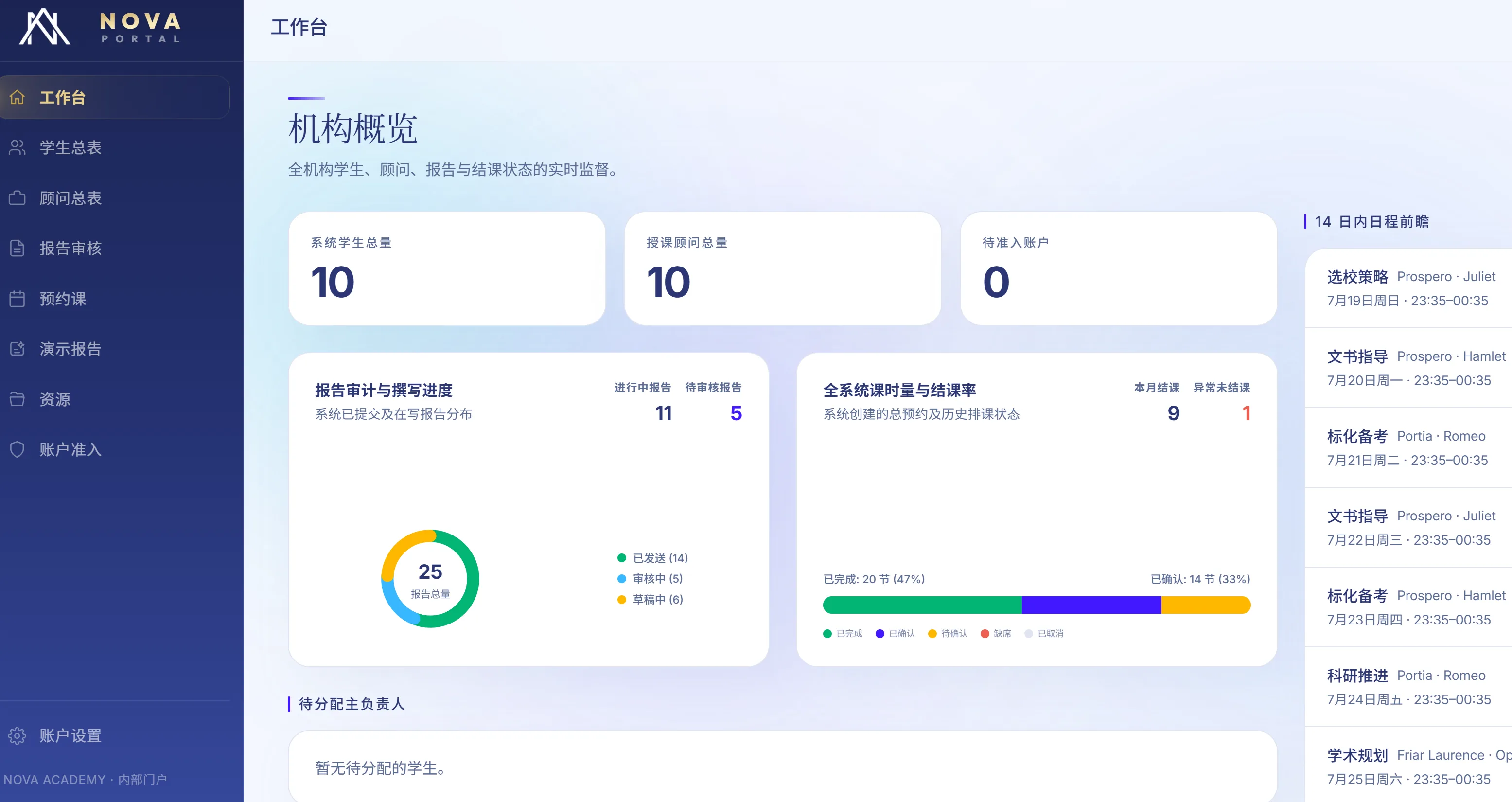
- Admin dashboard. Full institutional view, permission-tiered.
Conversion architecture
Two kinds of visitor, one page
We didn't build the marketing site to the brief either. We asked first where the traffic actually comes from.
Someone arriving from Xiaohongshu or WeChat already knows what the firm does. They have read the posts and watched the videos. They are on the site for one reason, to check that this is a real operation worth three years of their child's life.
Someone arriving from a search engine knows nothing yet and needs the basics.
Those two readers want opposite things. One is verifying, one is learning. We ordered the information for the verifier and pitched the depth for the newcomer, so the same page does both jobs.
Competitive positioning
Competing on Verifiable Process Management
A more fundamental question surfaced while we were working through the content.
Every firm in this market sells the same two things, faculty pedigree and years in business, and the older houses will always have more of both. That contest is decided before it starts.
This client had something none of them had. The entire service process existed as data, stage by stage, because the system we were building made it so.
Parents don't buy CVs. They buy a place at a good school, and credentials are one route there. Verifiable process management is another, and nobody was standing on it. We recommended building the position there, and replanned the system to match:
- Automated monthly parent reports.
- Quarterly and annual reports added for longitudinal narrative.
- Report content expanded from raw logs into comparable, revisitable milestone insights.
- Phase 1 roadmap: structuring the 3-year parent journey into data milestones.
The core deliverable
What the parent actually receives
This is what the whole argument was built toward. A report that reaches the family every month, that nobody had to assemble by hand.
Automated, immutable monthly progress report delivered directly to parents.
System architecture
Strategic Service Blueprint
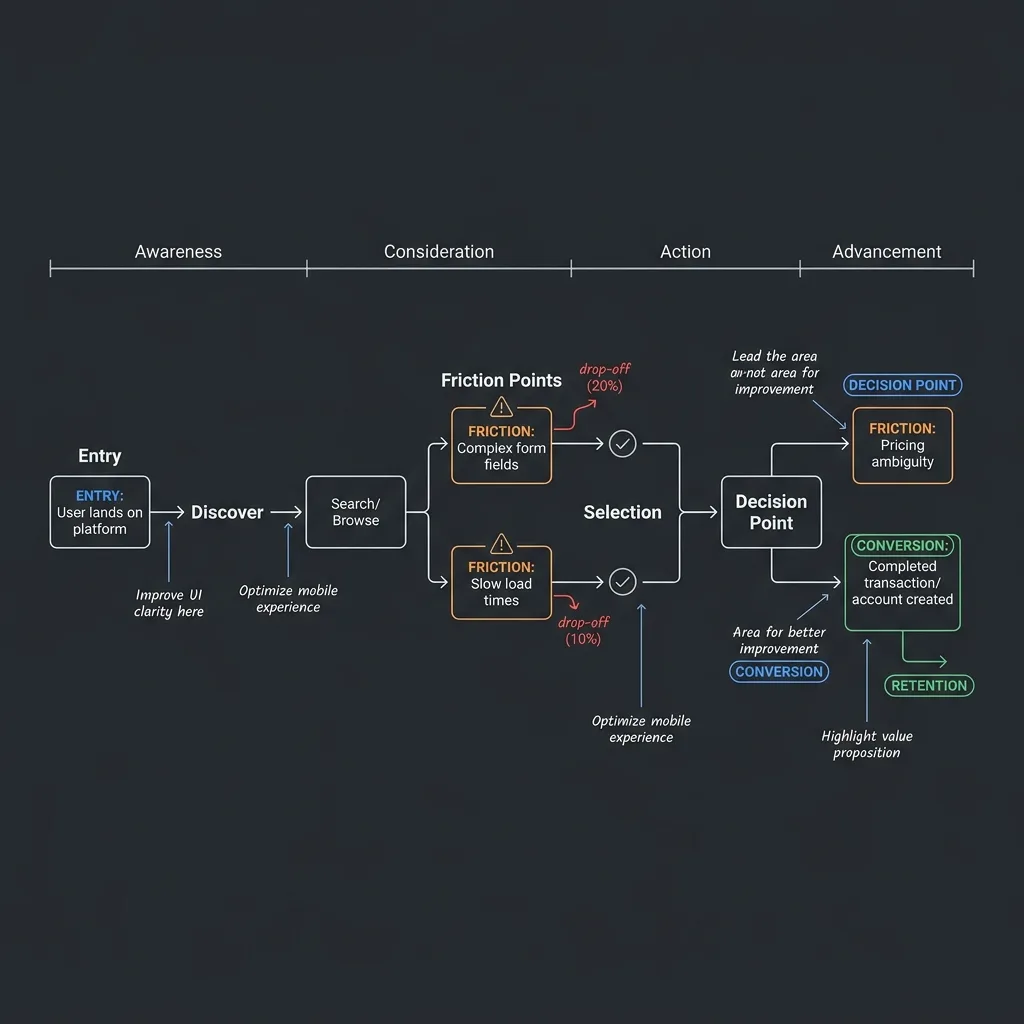
Service blueprint from discovery. It maps what the family experiences, what the institution has to do, and what the platform has to support at each stage. The module list came out of this, not the other way round.
- Discovery — user goals: identify personalized curriculum, evaluate platform credibility. Client goals: optimize acquisition funnel, contextualized onboarding. Platform core: unified learner data wallet, frictionless onboarding.
- Engagement — user goals: interactive skill mastery, peer & mentor collaboration. Client goals: increase completion rates, build vibrant community. Platform core: cross-cohort analytics, dynamic progress tracking.
- Retention & LTV — user goals: career outcome realization, lifelong learning access. Client goals: boost alumni referrals, continuous LTV expansion. Platform core: automated milestone reports, AI-driven advisory tools.
Security & compliance
Proactive Data Compliance & US-Resident Infrastructure
Student records contain sensitive personal information and academic history.
Prior to deployment, we completed a thorough compliance review, migrating storage and databases to compliant US-resident cloud infrastructure with tiered role permissions and access logging.
Delivered as an integral engineering standard. In high-value advisory, data integrity and student privacy are foundational to institutional reputation.